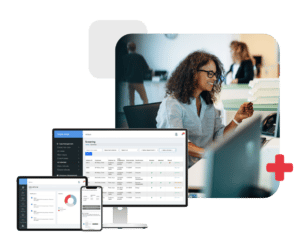


When occupational health data sits apart from the wider health record, organisations lose sight of how work and health truly interact. You can’t spot patterns, track outcomes, or see the real story of workforce wellbeing, just fragments of it.
That disconnect is the legacy of a system built for paperwork, not prevention. For years, occupational health records lived in filing cabinets, spreadsheets, or isolated databases, separate from the digital health systems that transformed other areas of care. The result has been slower decision-making, duplicated data, and missed opportunities to identify risks before they become costly health problems.
Digital occupational health records change that. They bridge the gap between workforce data and clinical insight, turning what was once administrative documentation into an active health management tool. When records are digital, connected, and secure, they allow employers and clinicians to collaborate, monitor trends, and take action early—protecting both employee wellbeing and organisational performance.
A 2023 study published in the Journal of Occupational Medicine and Toxicology found that organisations integrating occupational health data into broader clinical systems reported significantly improved coordination of care and faster decision-making across teams. In essence, digitized OH records have the power to transform the entire workplace health management system, allowing clinicians, HR teams, and managers to work from the same accurate, real-time information that results in earlier intervention and more consistent case management.
Centralised Health Data for Smarter Decisions
When health data is scattered, every assessment or report becomes an isolated task. Digital occupational health records bring everything together into a single, searchable system. That shift from fragmentation to centralisation is where real intelligence begins. With all data in one place, clinicians can trace patterns that used to stay hidden. Rising cases of repetitive strain injury in one department? Increasing stress referrals during peak business cycles? Centralised records make these trends visible, enabling early intervention before they affect productivity or safety.
Beyond efficiency, digital OH records provide something paper never could: the ability to connect data points across time. A clinician can instantly review a worker’s full exposure history, while managers can assess whether interventions are having measurable impact. This not only supports compliance but also helps quantify the return on investment in workplace health initiatives.
The impact goes further. When occupational health data is unified, it supports evidence-based decision-making. For example, anonymised trend analysis can reveal which job roles carry the highest risk of recurring health issues, guiding ergonomic redesign or targeted training. Over time, this builds an institutional memory, a dataset that captures how work affects health and how health affects work. That knowledge helps organisations move from reactive case management to preventive planning.
Centralisation also strengthens collaboration. HR, safety, and clinical teams can work from the same version of the truth, rather than chasing updates through emails or spreadsheets. In practice, this shortens referral times, reduces duplication, and ensures that the right people are involved at the right stage.
Audit Readiness and Compliance Management
Every medical assessment, surveillance record, or consent form must be accurate, complete, and readily available for review. When records are paper-based or dispersed across different systems, even simple audit requests can turn into days of retrieval and reconciliation.
Digital occupational health records remove that friction. Each entry is time-stamped, securely stored, and linked to the relevant case, ensuring that every version of a document can be traced from creation to closure. Whether it’s evidence of a completed health surveillance programme or a history of fitness-for-work assessments, authorised users can find what they need in seconds.
This precision becomes invaluable during inspections or internal reviews. Instead of manually cross-checking forms and reports, auditors can verify compliance through structured data and digital audit trails. It also reduces the risk of missing documentation, one of the most common compliance failures in occupational health management.
Digital systems also encourage a culture of accountability. With processes embedded into the software, such as automated reminders for upcoming surveillance or expiring certificates compliance becomes proactive. Clinicians spend less time chasing paperwork and more time focusing on clinical priorities.
For organisations managing large or distributed workforces, this is crucial. Regional or multi-site teams can operate under the same governance framework, with consistent processes and accessible oversight from a single source. Instead of reacting to audits, businesses stay perpetually audit-ready, which signals maturity in both health governance and operational management.
Improved Confidentiality and Data Security
Occupational health records contain some of the most sensitive information an organisation holds. They include medical assessments, psychological evaluations, vaccination histories, and sometimes personal details about an employee’s health condition or medication. When those records are kept on paper or stored in unsecured folders, confidentiality depends entirely on physical controls and human diligence, neither of which are fail-safe.
Digitising occupational health records strengthens confidentiality from the ground up. Access can be restricted by role, ensuring that clinicians, HR professionals, and managers each see only the information relevant to their responsibilities. Every access attempt is logged, every modification traceable. That level of transparency deters misuse and provides a clear audit trail if questions ever arise.
Security also improves through encryption, controlled sharing, and central oversight. Instead of attaching reports to emails or storing data on local drives, digital systems allow information to be viewed securely within the platform itself. This reduces the risk of accidental disclosure and ensures compliance with data protection requirements.
Just as important is the clarity digital systems bring to consent. Employees can be confident that their data is managed according to strict access rules, and organisations can demonstrate that consent is properly captured and honoured. In an age where trust defines employer-employee relationships, the ability to safeguard medical confidentiality is as much about culture as it is about compliance.
Integration with Broader Workforce Systems
Occupational health doesn’t operate in isolation. Every assessment, appointment, and report links to wider workforce processes such as HR onboarding, training, and absence management. When these systems aren’t connected, data must be re-entered manually, and important updates are easily missed.
Digital occupational health records solve this by integrating directly with other business systems. Job changes, department transfers, or updated risk profiles can flow automatically between platforms, reducing errors and keeping everyone aligned. This connection ensures that a change in one system, such as a new role requiring a different health surveillance schedule, immediately reflects in occupational health workflows.
Integration also improves communication between departments. HR teams gain better visibility into employee fitness-for-work status, line managers receive timely updates, and clinicians access accurate employment data without chasing for forms. The result is fewer administrative gaps and more cohesive health management across the organisation.
Ultimately, integration turns occupational health from a standalone service into part of the organisation’s wider data ecosystem; one that supports both operational efficiency and employee wellbeing.
Turning Insight into Action with Meddbase
Meddbase was built on the principle of data unification. Its cloud-based occupational health platform brings every assessment, surveillance record, and case file into one secure, integrated system. From automated workflows and role-based access to real-time reporting, Meddbase gives clinicians and employers the visibility they need to protect their workforce and stay compliant.
For organisations ready to move beyond fragmented record-keeping, Meddbase offers a foundation for proactive, data-informed health management. Because better insight means better care, and better care builds healthier businesses.